by
by They swallow light, bend time, and haunt the edges of our universe. Here’s everything we know — and why it matters.
A deep dive into the most extreme objects in the cosmos
Somewhere out there, roughly 26,000 light-years from Earth, sits an object so dense that nothing — not matter, not radiation, not even light itself — can escape its grip. We call it Sagittarius A*, the supermassive black hole at the centre of our own Milky Way. It weighs as much as four million suns, yet in cosmic terms, it’s a fairly modest specimen. And for most of human history, we didn’t even know it existed.
Black holes are perhaps the strangest objects in the known universe. They challenge our intuitions about space, time, and the very fabric of reality. To understand them is to glimpse the outer limits of physics itself.
What exactly is a black hole?
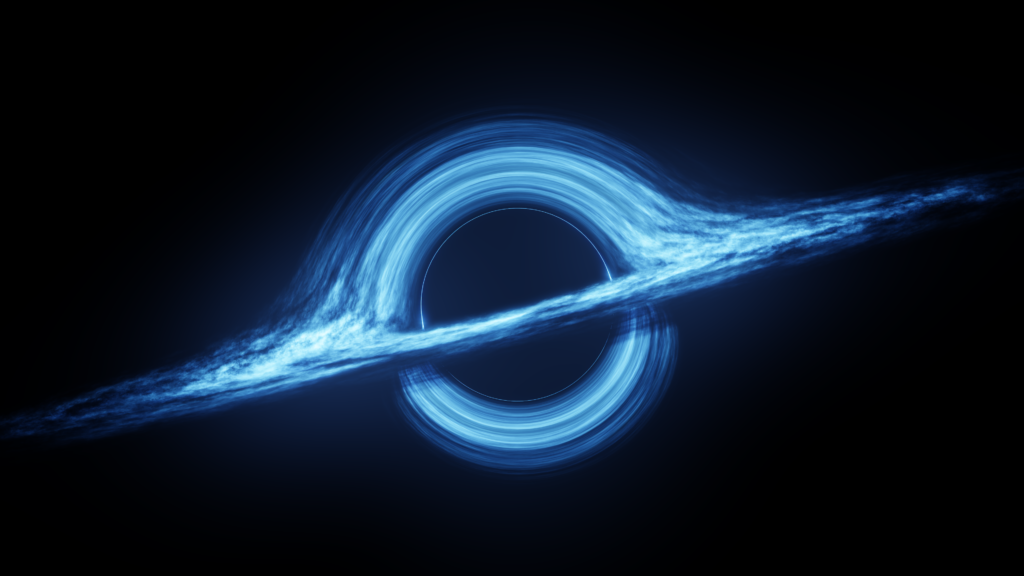
A black hole is a region in space where gravity has become so overwhelmingly powerful that the escape velocity — the speed you’d need to travel to break free of its pull — exceeds the speed of light. Since nothing in the universe travels faster than light, nothing can escape. Not rockets, not photons, not information.
The boundary beyond which escape becomes impossible has a name: the event horizon. Cross it, and you’re not coming back. But the event horizon isn’t a wall or a surface. It’s more like a point of no return — invisible, intangible, and absolutely final. An unlucky astronaut drifting through it might not even notice the moment of crossing, though what happens next is another matter entirely.
“A black hole has no hair,” John Wheeler once quipped — meaning it only cares about mass, charge, and spin. Everything else is irrelevant.”
Is it actually a “hole” in something?
Despite the name, a black hole isn’t a hole in the way we’d normally imagine — it’s not a gap or a void punched through space. It’s more accurate to think of it as an extreme concentration of mass compressed into an extraordinarily small volume, so compact that its gravitational field becomes inescapable.
At the very centre lies the singularity — a point where our current mathematics breaks down completely. Density becomes infinite. Spacetime curvature reaches values our equations can’t sensibly describe. Whether the singularity is a physical reality or simply a sign that our theories need updating is one of the deepest open questions in physics.
The “hole” metaphor does capture one truth, though: things go in and don’t come out. In that functional sense, it behaves like a drain in the bathtub of the universe.
How do black holes form?
The most common route begins with a massive star — one at least eight to twenty times heavier than our sun. For millions of years, such a star burns furiously, its nuclear furnace producing enough outward pressure to resist the inward crush of gravity. It’s a delicate balance, held in place by the constant release of energy.
When the fuel runs out, everything changes. The pressure drops. Gravity wins. The star’s core collapses in a fraction of a second, and the outer layers come crashing inward before rebounding in a catastrophic explosion — a supernova. If the collapsing core is massive enough, it doesn’t stop. It keeps shrinking, past the density of neutron stars, past every known threshold, until it disappears behind an event horizon. A black hole is born.
But not all black holes form this way. The supermassive black holes that lurk at the centres of most galaxies — including our own — likely formed through a combination of mergers, the collapse of enormous gas clouds in the early universe, and billions of years of steady growth. How exactly the first giant black holes came to be so massive, so quickly, after the Big Bang remains one of cosmology’s most heated debates.
STELLAR MASS5 – 100 M☉
SUPERMASSIVEMillions to billions M☉
MILKY WAY BH~4 million M☉
LARGEST KNOWNTON 618 — 66 billion M☉
How big are they?
Black holes come in a surprisingly wide range of sizes. Stellar-mass black holes — the kind born from dying stars — typically range from about five to a hundred times the mass of the sun, compressed into a sphere perhaps 30 to 300 kilometres across. Not enormous by astronomical standards, but packing the mass of multiple suns into something smaller than a city.
At the other extreme are supermassive black holes, which anchor the centres of galaxies. The one photographed by the Event Horizon Telescope in 2019, at the heart of galaxy M87, has a mass of 6.5 billion suns and an event horizon wider than our entire solar system. TON 618, the largest black hole we know of, tips the scales at 66 billion solar masses.
There’s also theoretical speculation about intermediate-mass black holes in the hundreds of thousands of solar masses range, and primordial black holes — hypothetical relics from the early universe that might be tiny, even microscopic. Evidence for both remains elusive but actively sought.
Who first discovered them — and when?
The idea has a longer history than most people realise. In 1783, English clergyman John Michell proposed the existence of “dark stars” — objects so massive that light couldn’t escape their gravity. French mathematician Pierre-Simon Laplace made a similar calculation independently in 1796. Both were largely forgotten.
The modern theory traces to 1916, when German physicist Karl Schwarzschild found the first exact solution to Einstein’s field equations of general relativity — a solution that implied an inescapable region of collapsed spacetime. He did so while serving in the German army on the Russian front, sending his derivation to Einstein from the trenches. He died months later. Einstein himself was reportedly sceptical that such extreme objects could actually exist in nature.
The term “black hole” was coined much later, popularised by physicist John Archibald Wheeler in a 1967 lecture. It stuck immediately — partly because it was so evocative, and partly because the alternatives (“gravitationally completely collapsed star” being one) were cumbersome enough to deserve extinction.
What Einstein predicted — and got right
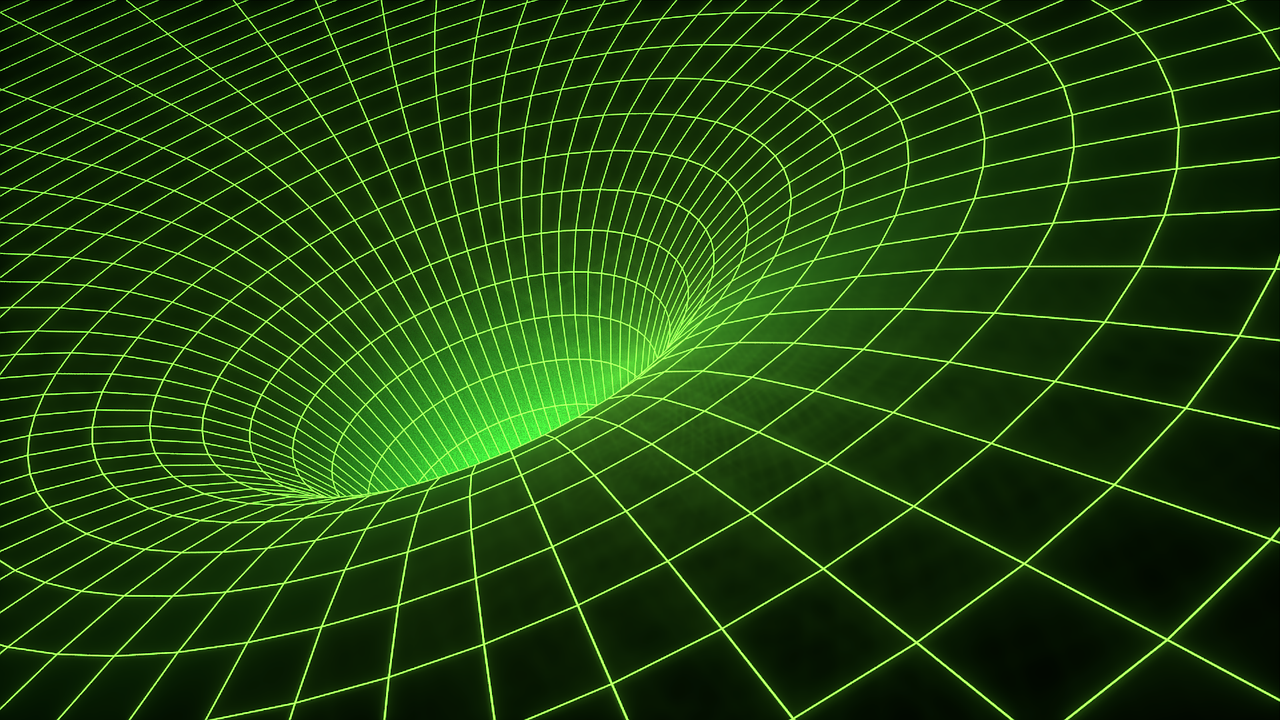
Einstein never intended to predict black holes. His general theory of relativity, published in 1915, was a new description of gravity — one that reimagined it not as a force, but as the curvature of spacetime caused by mass and energy. A massive object like the sun bends the fabric of space around it, and other objects follow the curves.
What his equations implied, however, was radical. They suggested that sufficiently massive objects could curve spacetime to the breaking point. They predicted that gravity could slow time — a phenomenon now confirmed to GPS satellites, which must correct their clocks for relativistic effects. They predicted gravitational lensing, the bending of light around massive objects — first observed during a solar eclipse in 1919. They predicted gravitational waves — ripples in spacetime itself — detected for the first time only in 2015, a full century later.
“Every prediction Einstein made about extreme gravity has been confirmed by observation. That’s not luck. That’s the rarest thing in science: a theory that just keeps being right.”
And his equations predicted black holes, whether he liked it or not. Modern physics has vindicated him at nearly every turn.
Are black holes actually useful to humanity?
Not in any immediate, practical sense — you wouldn’t want one in your neighbourhood. But the study of black holes has driven enormous practical advances in ways that aren’t obvious at first glance.
The GPS navigation system in your phone depends on corrections derived from general relativity — the same physics that governs black holes. Quantum computing research has drawn on theoretical insights from black hole thermodynamics. The mathematics of event horizons has applications in materials science and condensed matter physics through a principle called the AdS/CFT correspondence.
Theoretically, rotating black holes — known as Kerr black holes — could in principle be used as enormous energy sources, a concept physicised Roger Penrose described in 1969. The “Penrose process” allows energy to be extracted from the ergosphere just outside a spinning black hole’s event horizon. It remains purely theoretical, but some researchers speculate about advanced civilisations exploiting such processes.
Perhaps more importantly, black holes are natural laboratories for physics at its most extreme. Studying them tests our theories in conditions we could never create on Earth, pushing science toward whatever comes after general relativity and quantum mechanics.
What dangers do they pose?
The short answer: very little to humanity in any foreseeable future. The nearest known stellar-mass black hole is roughly 1,000 light-years away. At that distance, it exerts essentially no influence on Earth whatsoever.
For something to be gravitationally dangerous, you’d need to be extraordinarily close. Even our galactic centre’s supermassive black hole — Sagittarius A* — poses no threat at 26,000 light-years’ distance. It’s simply too far. The dramatic movie image of a black hole “sucking in” distant objects is largely fictional; they obey the same gravitational rules as any other object of equivalent mass. If our sun were somehow replaced by a black hole of equal mass tomorrow (and you’d have other problems), Earth’s orbit would remain unchanged.
The genuine risk scenarios are theoretical and remote: the unlikely possibility of a rogue black hole drifting into our solar system over billions of years, or speculative concerns about what happens as the Milky Way eventually merges with the Andromeda galaxy, potentially disturbing the orbits of stars near each galactic centre. On human timescales, these are not pressing concerns.
What has the study of black holes taught us?
Possibly more than any other single subject in modern science. Black holes sit at the intersection of our two best theories of physics — general relativity and quantum mechanics — and they refuse to let either one off the hook. The famous information paradox, first articulated by Stephen Hawking, asks a deeply unsettling question: if a black hole gradually evaporates over billions of years through what’s now called Hawking radiation, what happens to all the information about the matter it swallowed? Does it disappear? Most physicists believe information can never truly be destroyed — but reconciling that belief with Hawking’s calculations has occupied some of the brightest minds in theoretical physics for fifty years.
The first direct image of a black hole’s shadow, captured by the Event Horizon Telescope in 2019 — that glowing orange ring around a dark centre — wasn’t just a beautiful photograph. It confirmed, again, that Einstein’s predictions were correct even in the most extreme environment we can observe. The first detection of gravitational waves from merging black holes in 2015 opened an entirely new way of “listening” to the universe, founding the field of gravitational wave astronomy.
Black holes have also transformed how we think about entropy, information, and the nature of spacetime itself. The discovery that black holes have temperature and entropy — that they behave, in a deep sense, like thermodynamic objects — hints at a profound connection between gravity, quantum mechanics, and information theory that we don’t yet fully understand.
A closing thought
There’s something fitting about the fact that the universe’s most extreme objects have driven some of our deepest thinking. Black holes force us to confront the limits of what we know — not as a defeat, but as an invitation. Every paradox they present, every observation that confirms a century-old prediction, every unanswered question about what happens at a singularity is a reminder that the universe is stranger, more intricate, and more astonishing than anything we could have imagined sitting around a fire ten thousand years ago.
We will keep looking. And the black holes will keep waiting.
Discover more from 𝙲𝙷𝙰𝚁𝚄𝚅𝙰𝙺.𝙲𝙾𝙼
Subscribe to get the latest posts sent to your email.