by
by The Big Bang Theory – The Most Widely Accepted Theory About the Creation of the World
What is the Cosmos?
When we use the word cosmos, we’re referring to the grand total of everything that exists—space, time, matter, energy, and the laws that govern them. It’s a term that carries a sense of order. The ancient Greeks used kosmos to mean harmony or arrangement, suggesting that the universe isn’t random chaos but something structured and intelligible.
The cosmos includes not just stars and galaxies, but also the invisible frameworks—gravity, quantum fields, dark matter—that shape what we see. It is, in a sense, reality in its most complete form.
What is a Universe?
A universe is often used interchangeably with cosmos, but it can be thought of more specifically as the observable system we inhabit. It includes everything we can detect or infer: galaxies, planets, radiation, and the expanding fabric of space-time.
Modern physics sometimes entertains the possibility of multiple universes—a multiverse—but when we speak of the universe, we usually mean our own observable one, which stretches about 93 billion light-years across.
How Did the Cosmos Come Into Being?
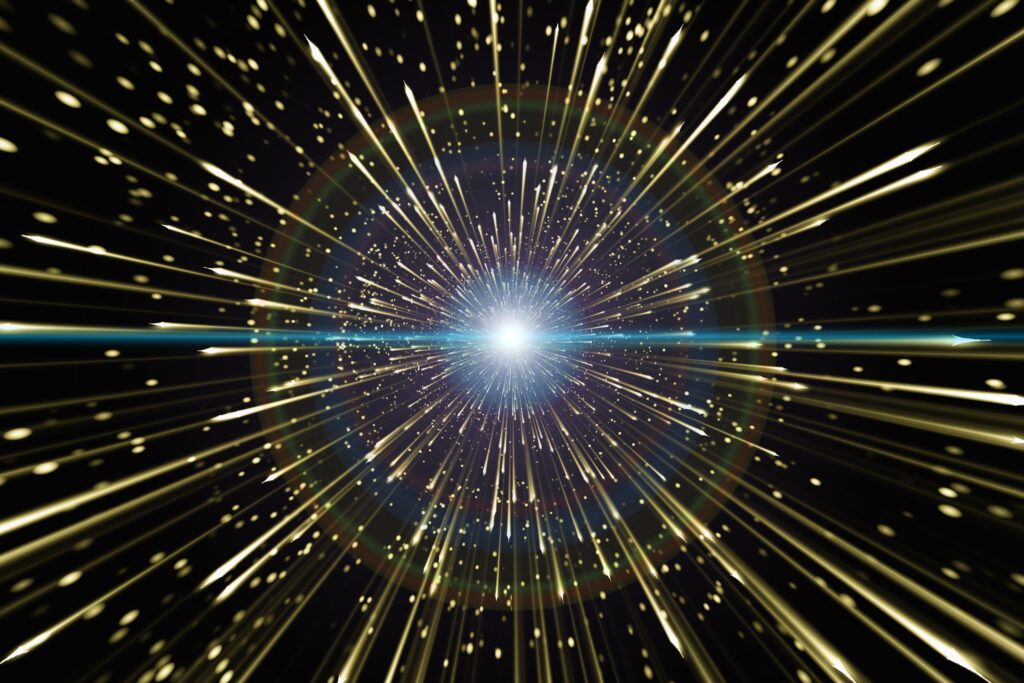
This is where the Big Bang Theory enters. According to this theory, the universe began roughly 13.8 billion years ago from an extremely hot, dense state. It wasn’t an explosion in space—it was an expansion of space itself.
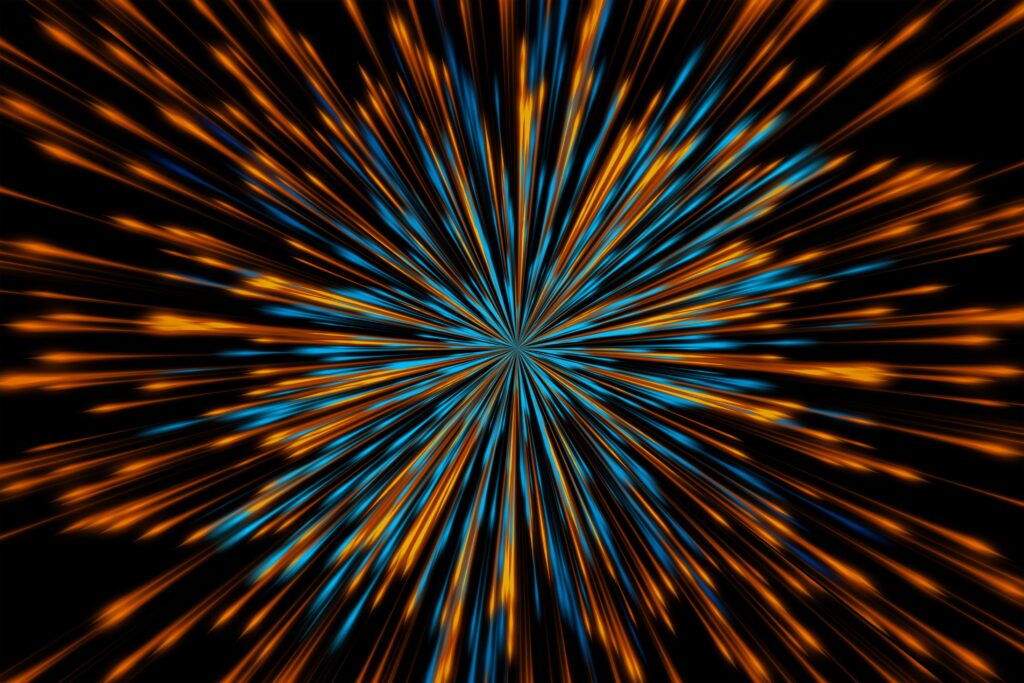
In its earliest moment, the universe was unimaginably small, dense, and hot. Then, in a fraction of a second, it began to expand rapidly. As it expanded, it cooled, allowing energy to convert into particles, then atoms, and eventually stars and galaxies.
Interestingly, the theory doesn’t describe what happened before the Big Bang. In fact, time itself is believed to have begun at that moment. Asking “what came before?” may not even be a meaningful question in this framework.
Who Gave the Big Bang Theory?
The foundations of the Big Bang Theory were laid by Georges Lemaître in the 1920s. He proposed that the universe began from a “primeval atom.”
Later, Edwin Hubble provided observational support by discovering that galaxies are moving away from us—evidence that the universe is expanding.
The term “Big Bang” itself was coined by Fred Hoyle, somewhat ironically, as he initially opposed the theory.
How Can We Say That the Universe is “Created”?
The word created can be misleading. In science, it doesn’t necessarily imply a creator or intentional act. Instead, it refers to the transition from a state where the universe as we know it did not exist, to one where it does.
The Big Bang marks the beginning of space, time, and physical laws. So rather than “creation” in a philosophical sense, it’s more like the starting point of everything we can study scientifically.
What is the Mathematics Involved in the Theory?
At the heart of the Big Bang Theory lies General Relativity, developed by Albert Einstein.
One of the key equations used to describe the expanding universe is:
H^2 = \frac{8\pi G}{3}\rho – \frac{k}{a^2} + \frac{\Lambda}{3}
This is a simplified version of the Friedmann equation, which relates the expansion rate of the universe (H) to its energy density (ρ), curvature (k), and cosmological constant (Λ).
Another important relation comes from the observed expansion:
v = H_0 d
This is Hubble’s Law, showing that galaxies move away from us at speeds proportional to their distance.
How Do We Know That It’s True?
The Big Bang Theory is supported by several strong pieces of evidence:
- Cosmic Microwave Background Radiation (CMB): Discovered in 1965, this faint radiation is considered the afterglow of the early universe.
- Expansion of the Universe: Observations show galaxies moving away from each other.
- Abundance of Light Elements: The predicted amounts of hydrogen, helium, and lithium match observations.
Together, these form a consistent picture that strongly supports the theory.
What Scientific Advancements Have Come From This Theory?
The Big Bang Theory has driven major developments in:
- Cosmology – the study of the universe as a whole
- Particle physics – understanding fundamental particles
- Space exploration technologies
- Satellite missions like COBE, WMAP, and Planck that mapped the early universe
It has also deepened our understanding of phenomena like black holes, dark matter, and dark energy.
What Have We Figured Out Using This Theory?
Using the Big Bang framework, scientists have been able to:
- Estimate the age of the universe (~13.8 billion years)
- Understand how galaxies and stars formed
- Trace the evolution of cosmic structure
- Identify different eras of the universe (inflation, recombination, etc.)
Are There Any Mistakes or Updates in the Theory?
The Big Bang Theory isn’t perfect or complete. Some open questions include:
- What exactly caused the Big Bang?
- What is dark matter and dark energy?
- Why is the universe expanding at an accelerating rate?
The theory has been refined over time, especially with the addition of cosmic inflation—a rapid expansion phase proposed to explain certain observations.
Are There Any Alternative Theories?
Yes, several alternatives have been proposed:
- Steady State Theory – suggests the universe has always existed in a constant state
- Cyclic Models – the universe undergoes repeated expansions and contractions
- Multiverse Theories – our universe is just one of many
While interesting, none currently match the observational support of the Big Bang Theory.
How Does It Change Our Perspective Towards Life?
The Big Bang Theory places humanity in a vast, evolving universe. It suggests that everything—from atoms in our bodies to distant galaxies—shares a common origin.
This can be humbling. It can also be strangely unifying. The carbon in your body was forged in stars that existed billions of years ago. In a very real sense, we are part of the cosmos becoming aware of itself.
Conclusion
The Big Bang Theory stands as one of humanity’s greatest scientific achievements. It doesn’t answer every question, nor does it claim to. But it offers a coherent, evidence-based account of how the universe came to be as it is today.
What makes it powerful is not just what it explains, but how it invites further questions. The story of the universe is still unfolding—and we are both observers and participants in that story.
Discover more from 𝙲𝙷𝙰𝚁𝚄𝚅𝙰𝙺.𝙲𝙾𝙼
Subscribe to get the latest posts sent to your email.