by
by The W Boson Field: The Charged Carrier of the Weak Force
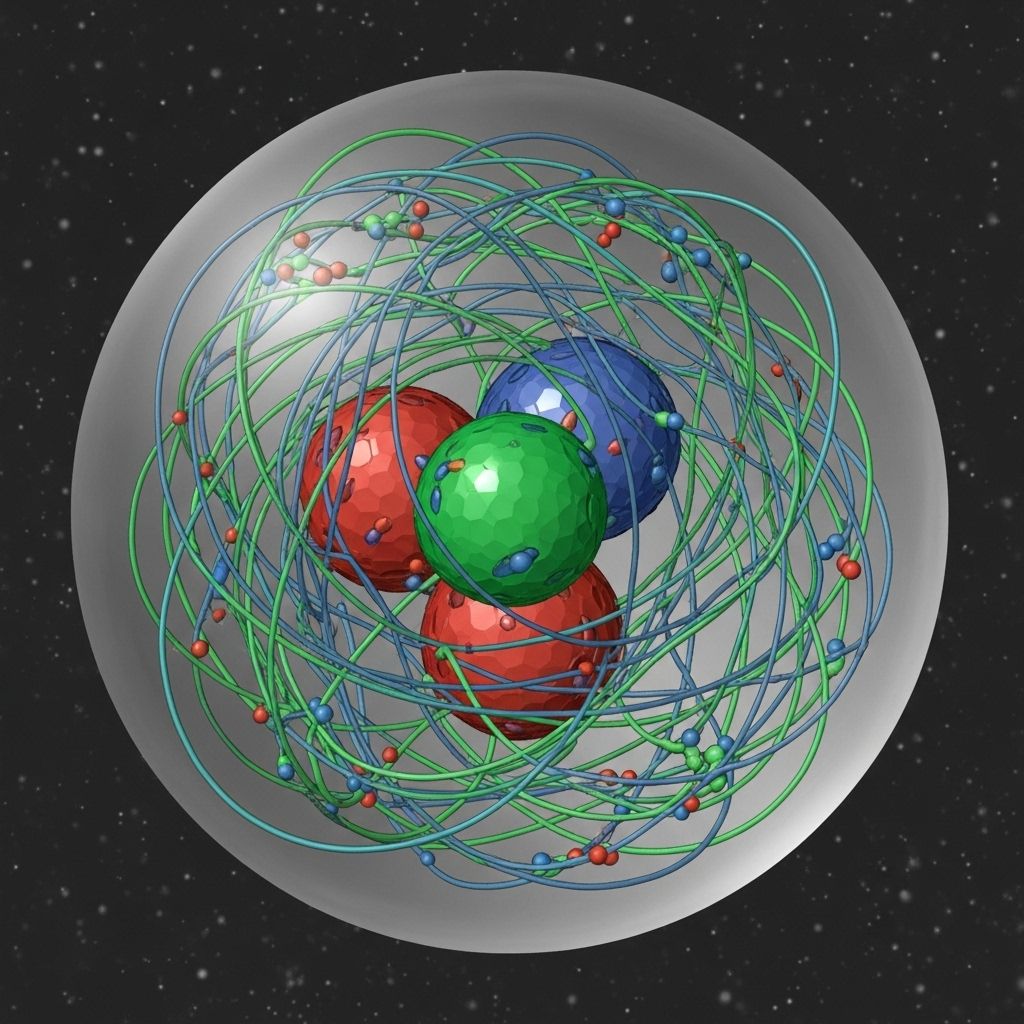
I’ve been thinking a lot lately about how the universe manages to change one kind of particle into another. Not just shuffling energy around—actually transforming identities, like a neutron turning into a proton while spitting out an electron and an antineutrino. That’s the weak force at work, and it doesn’t use photons or gluons. It uses the W boson (and its neutral cousin the Z, but today we’re focusing on the charged ones). The W± boson is the heavy, short-lived messenger that carries the charged weak current, and like everything else, it’s really an excitation in its own quantum field.
This one feels different from the photon or gluon fields—it’s massive, unstable, and only shows up in fleeting, high-energy moments. But without it, stars wouldn’t burn the way they do, and matter as we know it wouldn’t have settled into its stable forms.
What exactly is a field in physics?
By now you’ve heard it: space is soaked in quantum fields. Each point has a value, usually zero. Excite it, and you get particles as quantized vibrations. The W boson field is a complex vector field (actually two, for W+ and W-), part of the SU(2) gauge symmetry in the electroweak sector. It’s not abelian like electromagnetism; the fields interact among themselves in subtle ways, but the key is that the Higgs mechanism gives it mass, breaking the symmetry and making the weak force weak.
So what’s a W boson?
The W boson comes in two charged versions: W+ (charge +1) and W- (charge -1), spin 1, mass around 80.4 GeV—roughly 85 times a proton. It’s incredibly short-lived, decaying in about 3×10^{-25} seconds. Main decay modes: to a lepton plus neutrino (eν, μν, τν) or to quark-antiquark pairs (like ud, cs, etc., with branching ratios favoring hadronic decays at ~67%). It was discovered in 1983 at CERN’s SPS collider by UA1 and UA2, confirming the electroweak theory. Recent LHC measurements (ATLAS, CMS) pin the mass at roughly 80,360–80,366 MeV, consistent with Standard Model predictions after some earlier tension got resolved.
What is the W boson field?
It’s the quantum field whose excitations are W+ and W- bosons. In the electroweak Lagrangian, it’s part of the SU(2)L gauge field triplet (W^1, W^2, W^3). The charged combinations are W± = (W^1 ∓ i W^2)/√2. The field couples to left-handed fermions (and right-handed antifermions) via the weak isospin current. Because it’s massive (thanks to the Higgs vev breaking SU(2)×U(1) to U(1)em), the propagator has 1/(q² – M_W²), which makes interactions short-range and weak at low energies. Virtual W bosons mediate flavor-changing processes, beta decay, muon decay—everything where quark or lepton flavors shift.
W boson field and the existence of… well, stable matter and stellar fusion
This field is why we have the pattern of stable matter we see. Without charged weak interactions, neutrons couldn’t decay into protons (n → p e ν-bar), so we’d have equal numbers of protons and neutrons, messing up Big Bang nucleosynthesis—no helium dominance, wrong light-element abundances. In stars, the pp chain (proton-proton fusion) relies on weak processes: two protons → deuteron + positron + neutrino via virtual W exchange. The Sun would fizzle without it. The field also enforces charge conservation in decays, letting heavier generations decay down to up/down/electron. Flip off the W field, and the universe stays in a primordial soup of mixed flavors—no clear separation into stable atoms.
W boson field and gravity
Gravity doesn’t pick favorites—it sees energy and momentum. The W boson’s huge mass means its field excitations contribute to gravitational curvature, but only in extreme, short-lived events (colliders, early universe). In quantum terms, the weak force is fully quantized in the Standard Model, while gravity remains stubbornly classical. No graviton, no consistent quantum gravity. The W field lives happily in curved spacetime (general relativity background), but at Planck scales where quantum gravity effects matter, we have no clue how the massive gauge fields behave. Some theories (string theory, etc.) try to embed electroweak bosons in bigger structures, but nothing experimental yet. The weak force’s parity violation and chirality add extra wrinkles—gravity treats left and right the same.
How does knowing all this actually change how you look at life?
It makes transformation feel fundamental. Your body runs on chemistry built from stable up/down quarks and electrons, but that stability came from the weak force weeding out unstable combinations over billions of years. Every breath you take involves oxygen from stellar fusion powered by weak processes. The fact that nature picked three generations, with heavier ones decaying via W bosons, hints we’re living in a “settled” version of reality—one where the weak force cleared the stage for long-lived matter. It also reminds me how fragile balance is: tiny mismatches in couplings or masses could have left the universe radiation-dominated or chemically barren. Makes everyday existence feel like a narrow escape from chaos, in the best way—grateful for the quiet work of these massive, fleeting fields.
Wrapping it up
The W boson field (and its charged excitations W±) is the engine of flavor change in the Standard Model—the charged carrier of the weak force that lets particles transmute, powers stars, and shaped the cosmos after the Big Bang. Massive thanks to the Higgs, short-ranged, parity-violating, and crucial for the matter we see. LHC keeps testing it to exquisite precision, and so far it holds up. Gravity still looms as the outsider, but the W field shows how elegantly the other forces unified and broke apart. Every radioactive decay, every neutrino from the Sun, traces back to this field doing its job. That’s the quiet power behind the scenes—making change possible, one fleeting boson at a time.
Discover more from 𝙲𝙷𝙰𝚁𝚄𝚅𝙰𝙺.𝙲𝙾𝙼
Subscribe to get the latest posts sent to your email.